BDLI Industry Data 2026: Aerospace Industry Sets New Records for Revenue and Employment

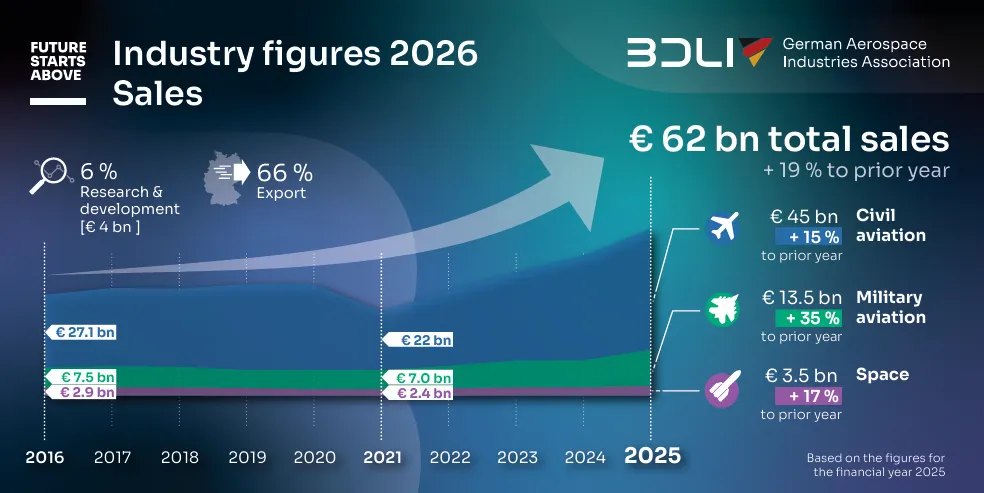
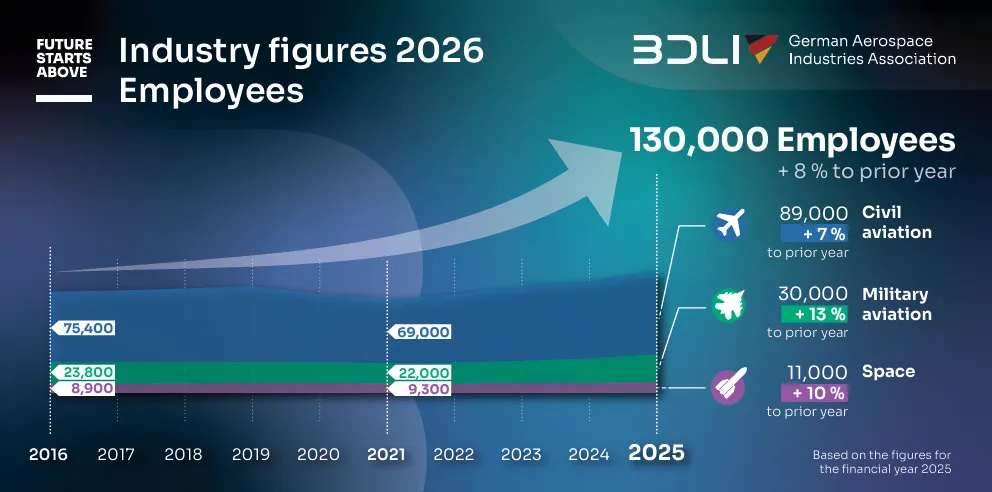
Berlin, May 27, 2026 – The German aerospace industry continued and accelerated its growth trajectory last year. The sector’s total revenue rose to 62 billion euros (previous year: 52 billion euros), an increase of 19 percent over the previous year. Employment also reached a new high with 130,000 employees (previous year: 120,000).
“Technological sovereignty determines our ability to act in terms of both the economy and security policy. The German aerospace industry is among the most innovative and fastest-growing industries in our country. Our companies are highly competitive internationally. However, maintaining and expanding this position is becoming more challenging in the face of global competition,” said Dr. Michael Schöllhorn, President of the German Aerospace Industries Association (BDLI), during the presentation of the industry data.
With revenue of 45 billion euros, civil aviation remains the industry’s largest segment, representing 15 percent growth compared to the previous year. This is due to strong international demand and the ongoing ramp-up of production in the aviation industry.
Military aviation showed dynamic growth. Revenue rose by 35 percent to 13.5 billion euros. The space sector also grew, achieving a 17 percent increase in revenue to 3.5 billion euros. As a result, all three segments of the German aerospace industry recorded double-digit growth rates in 2025.
“The figures show that the aerospace industry is strategically important to Germany—economically, technologically, and in terms of security policy. Especially in times of geopolitical and economic tension, industrial capabilities, innovative strength, and technological sovereignty make all the difference,” Schöllhorn continued.
Over the past ten years, industry revenue has grown by more than half. The sector has gained significant momentum, particularly since overcoming the COVID crisis and the shift in security policy. At the same time, companies face major challenges: fragile supply chains, increasing international competitive pressure, and a high demand for skilled workers.
In 2025, the industry invested around 4 billion euros (3.6 billion euros the previous year) in research and development, remaining one of Germany’s most research-intensive industries.
“Other regions and countries around the world are investing heavily in their aerospace industries. Europe and Germany must not fall behind in key technologies, production capacities, innovation, and ambition. Competitiveness does not happen on its own. It must be earned anew every day,” said Schöllhorn.
The industry’s export ratio stood at 66 percent in 2025. The German aerospace industry thus remains one of the country’s most internationally successful industrial sectors.
The latest industry developments will also be on display at ILA Berlin 2026. The international aerospace trade show will bring together industry, government, the armed forces, research institutions, and international partners in Berlin from June 10 to 14.